Monday, August 17, 2020

Bill's Garden Report


Bill’s Garden Report

“But though an old man, I am but a young gardener” Thomas Jefferson


It is that time of year again for my garden report. Actually, the garden isn’t yet finished as I still have green tomatoes, peppers that haven’t matured, and a few ears of corn not yet ready. However, my experience in preparing these blogs suggests that if I wait until everything in the garden is finished, I probably won’t get around to giving my report, so here it is, despite my hope that there will still be more  vegetables for our dinner table.

The brightest spot thus far in this year’s garden was the success of my snow peas and green beans. I planted both on opposite sides of a frame that I built to support the pole beans and the naturally tall snow peas. Both beans and peas seemed to like the frame that I erected in early spring. The only negative to their vigorous growth was the mama snapping turtle who decided that the soil surrounding the bean poles was a perfect spot to lay her eggs. So she did. Her motherly duties of digging a hole, inserting her tail and nether parts into it and then depositing a dozen eggs or more demonstrated she had zero concern for the damage done to my beans.  I repaired her damage after she left the garden and the beans and peas resumed their growing, yielding a surprising bounty of vegetables.

This year I purchased my seeds from Burpee’s mail order catalog. One of the intriguing things the catalog showed was miniature corn that could be planted in a patio container, according to the ad. Surely my small raised bed gardens could be used instead of a patio pot so I laid out my plans and marshalled the work bench in the barn in preparation of planting my seeds. We had a lot of cold, rainy weather when I decided it was time to plant. The consequences of this delay in my planting plans was that I left the seeds in their packages in my barn while I waited for warmer weather. It didn’t occur to me that mice might just enjoy my seed corn. They did. I found the package of seeds had been chewed with the largest part of my seeds missing and some partially chewed by tiny teeth. Disappointed but not undone, I planted everything that remained and anxiously awaited corn on the cob that I expected to harvest about now. It didn’t work out as I had hoped.

The seed fragments didn’t germinate. After a few weeks, I had only eight stocks of corn from the unmolested eight kernels and nothing from the seed fragments. The few stocks grew slowly. One night some sneaky critter dug up  five of the eight, leaving me three healthy corn plants with a total of five ears that I have been watching like a hawk. I haven’t pulled any of the ears yet, but I expect to feast on the paltry little things soon. I marked the corn experience as strike one in my battle to derive some benefit from all my labors in the garden.

In addition to the peas and beans, I had remarkable success with six kale plants that I purchased from our local greenhouse. It was the first time I had grown kale and I came to understand that many people don’t like the green, leafy veggie that can substituted for lettuce in a salad. I also came to understand that six healthy plants are enough to feed a family of eight or ten. Our family of two didn’t make a dent in consuming this prolific plant – just ask if you would like me to send you a year’s supply.

Strike two in my garden was the results of the three zucchini plants that I grew. They grew to enormous size and I watched over them with hot anticipation for a bumper crop of the tasty ‘tubers’ that I enjoy in salads or as a stand-alone veggie. Never mind the fact that they grew so large they covered their neighboring plants.  (Now I can’t tell what the neighboring were since they were smothered out of existence after several weeks. The huge zucchini also threatened the existence of four little tomatoes that are still struggling to make fruit.) I began searching thru the massive leaves  every day for my first zucchini treat, but I found that as soon as the flower on the newborn tuber dropped off, a rotten end became evident and I was forced to toss the little devils. I looked it up. It was blossom end rot. The garden book said the plants needed calcium. Almost unbelievable, the cure was said to be dosing the soil with a calcium supplement. I didn’t want to tell you this, but I dosed my zucchinis with Tums and sure enough the blossom end rot disappeared. At this writing I still have had only three or four little tubers, so I am ranking the experience as strike two.

Do you like sauerkraut? I do. The reason I like it is because the preparation of the kraut after you grow the cabbages is incredibly easy if you happen to own a large crock with a close-fitting lid. I happen to have such a useful article and I decided to put it to use again this year, never expecting that this would become my strike three occurrence for this year.

I grew four cabbages from seedlings and, as luck would have it, I placed them next to the ill-fated corn plants. Since the corn largely failed, the cabbages had the benefit of extra space and careful watering as I watched over my corn. The result was a crop of four large cabbages, fully formed and free of the nasty little worms that sometimes hide in the folds of the cabbage. Last week I decided it was time to harvest the attractive cabbage heads and begin the process of making kraut. My better half insisted that I follow a recipe for making the kraut to ensure the safety of the finished goods from the canning operation. I reluctantly agreed. The recipe said I needed 20 pounds of cabbage – my four weighed a measly seven pounds. I purchased three more cabbages from the farm market bringing my total to seven cabbages weighing in at 24 pounds since the farm market had even larger heads than I.

Last weekend I decided it was time to make the kraut. I set up my base of operations on the raised outdoor deck. I lugged the heavy six-gallon crock to the deck. While stopping to catch my breath, I did a quick calculation: I would be adding 24  pounds of cabbage and 3 or 4 quarts of brine to the crock bringing it to a total weight of … too much to carry up and down the six steps to the ground and the garage where I decided to ferment the kraut.

The new calculation provoked me into carving the cabbages on  the deck and carrying the shredded mess into large handfuls for transfer to the crock. I began. I had made 5 or 6 trips up and down the stairway when I began to notice a strange buzzing sound. On trip number seven the hornets had enough – they attacked. Three or four of the little devils stung my face and two got my right hand as I was desperately swatting at them. The battle was touch and go for a second, but I escaped their attack and made for the barn where awaited my hornet spray bottle full of a poison so deadly that even angry hornets shudder when they see me with the bottle in hand. It took me a few moments to regain my composure and retrieve the 2nd spray bottle that I needed after using an entire bottle on steps to the deck.

I went back to the tedious job of slicing the cabbages into slivers as small as I could make them. Another hour passed and stings became a distant memory as I watched the crock get fuller and the pile of seven cabbages get smaller. I was concentrating so intently on my cabbages that I didn’t happen to notice the grey clouds forming overhead. The clouds coalesced and a soaking rain began to fall. I calculated that it would be easier to get a little wet while I finished the job rather than to put away all my tools, find a place to store the uncut cabbages, and carry the  crock to the garage for safe keeping. I gritted my teeth, massaged the sting spots on my face and continued slicing the cabbage. A song popped into my head and I smiled while I sang, “Choppin’ broccoli, choppin’ broccoli.”

Another hour passed as I worked in the rain that had become a deluge. The fatigue that set in from the climbing, stinging, and rainfall made the making of sauerkraut the end of the inning for this year’s garden. I bet even Thomas Jefferson would have said “Whew!” or Damn! 

Awww well, next year’s garden should be even better with all the things that I learned not to do from this year.


Friday, July 31, 2020

Bill's Book Report

Bill’s book report about the newest ‘breakthrough’ book that has sold more copies in a shorter time than any other book in America; selling nearly one million books in one day


"Too Much and Never Enough"

How My Family Created the World’s Most Dangerous Man

By Mary L Trump, PH. D.


This book is about Donald Trump written by his niece, a clinical psychologist who lived in the Trump family home along with Donald and his brothers and sisters for an extended period due to the death of her father, Donald’s oldest brother.

Mary explains the reason for the book in the closing lines of the book’s prologue.

“The events of the last three years, however; have forced my hand and I can no longer remain silent. By the time this book is published hundreds of thousands of American lives will have been sacrificed on the altar of Donald’s hubris and willful ignorance . If he is afforded a second term, it would be the end of American democracy.”


The book opens with a recounting of the Trump family history beginning with an immigrant from Germany, Friedrich Trump who left Germany in 1885 to avoid mandatory military service. He came to New York after an extended period in British Columbia where he developed an ownership status in several restaurants and brothels. He returned to Germany but was told by authorities that Germany was no longer his lawful home since his skipping out to avoid the draft was extremely bad form. He returned to New York with a bride in hand and the couple began a family, using the fortune from his Canadian investments to begin housekeeping in Queens, NY.

Two sons and a daughter soon arrived, all of whom grew up speaking German in the Trump household. The oldest boy was given the anglicized name of Fredrich for his father. In a twist of fate, the original Friedrich died prematurely when he contracted a corona virus then known as the Spanish flu in 1918 and the 12-year-old Fred became master of the house and the sudden wage earner for the family. The youngster took his sudden elevation as family head seriously and he began doing odd jobs for neighbors to help his mother manage their expenses. They managed nicely since the original Friedrich had left a financial legacy – $300, 000, a sizeable inheritance for the time when the average wage was 22 cents per hour.

For some reason, the youngster who became known as Fred took an interest in construction and decided that he could build garages as a means of earning his fortune. The boy began to study the building trade intensely, having no other interests beyond garage building. With his mother’s help, he became successful, earning a builder’s license and constructing garages for the new-fangled automobiles that seemed to be cropping up everywhere.

The construction business exactly fit Fred’s personality and his need to be constantly busy in the business of earning money. As he matured, he began spending every minute of his free time pursuing his business as it became the single focus of his life. Fred was a high functioning sociopath, a rare but not uncommon condition afflicting 3% of the population, 75% of whom are men. Symptoms of sociopathy are a lack of empathy, a complete indifference to right or wrong, abusive behavior, a penchant for lying, and a complete disregard for the feelings and rights of others. Fred displayed each of these symptoms. His personal life with his family of three boys and two girls was dictated by his sociopathy and his absence as he worked most of the time, personally managing every detail of his growing business, and, at the end of each day, picking up and saving any nails that had fallen to the ground.

His wife and the mother of his children had her own problems. Her last pregnancy was difficult and the medical remedy at the time and place she was cared for involved the surgical removal of her ovaries and uterus. The sudden loss of her female hormones provoked the onset of severe osteoporosis, all of which was undetected at the time. Nine months later her oldest daughter Maryanne found her unconscious in bed and bleeding profusely. Maryanne awoke her father Fred who arranged for his wife’s emergency admission to a local hospital. Fred told Maryanne to help the younger children and then go to school and he would call her. Doctors told Fred that it was unlikely his wife would live another day. Maryanne expected the worse when she got the call from her father. “She is going to pull through,” he said, without any words of comfort or support for the youngster. Maryanne became the caretaker of the children including the baby Donald who was just 2 and ½ years old. From that point on, the children had little care from their mother and none at all from their father who continued his unrelenting attention to his work.

Fred’s single focus was the earning of ever more money without regard to the illegality of the practices he implemented. He expanded his construction business into one of development; retaining ownership of everything he built that he used as rental property. Soon the development and rental business exceeded his construction business as the weekly and monthly receipts poured in from his renters.

The oldest boy in the family was named Fred but called Freddy. Fred Senior occasionally took Freddy to work with him to begin learning the business. It didn’t work. Freddy soon became the object of Fred Senior’s abuse when he was unable to comprehend the subtleties of the business or display what Fred called ‘a killer instinct.’ The humiliating abuse often occurred within the hearing the 2nd son, Donald. The abuse became more severe and only ended when Freddy found excuses for not accompanying Fred Senior to work. Donald learned to avoid his father’s abuse by lying as he watched his older brother use that technique to escape abuse by inventing reasons to avoid the real estate business.

Freddy tried to escape the family business by joining the military. He was successful, well-liked by both his peers and officers. He decided to apply for flight training which ultimately led to him becoming a pilot. After his service, he continued flying, winning qualifications to become a commercial airline pilot. His continued success led him to become one of the long-distance airline pilots with enviable flight assignments from coast to coast. None of his successes was enough for Fred, he belittled his son’s choice of a career calling him a bus driver in the sky who earned a pittance compared to Fred’s earnings. The denigration of his skills by the man whom he most wanted to impress drove Freddy to despair. Donald watched from close-up as Freddy descended into alcoholism from his father’s continued abuse. Freddy died at age 42.

Donald was unable to control himself in High School. His atrocious behavior was disrupting classes and even Fred’s intervention was seen to be insufficient to ward off a scandal. The solution Fred reached was to remove Donald from his regular school and send him to a military school to help his wayward behavior. Surprisingly, Donald managed to follow the rigid rules and behave sufficiently well to graduate from the academy. After the military academy training, it was decided he should go to college. His older sister Maryanne helped with his homework and Donald paid another youngster to take his SAT tests for him to insure he would be qualified for university training. No one knows about Donald’s university grades or behavior since the President has threatened the school with lawsuits should they reveal his academic record.

Before Freddy’s death, Fred Senior had taken on a new project; the installation of his son Donald in the family business despite his earlier promise to Freddy. One part of the business that Fred had carefully cultivated was wining and dining politicians who had influence over New York’s zoning regulations and the awarding of lucrative building contracts. It was the singular thing that Donald could manage that didn’t require any knowledge of the building trades nor the work needed to manage the sizable rental business. Besides, Donald liked the idea of being seen with high-ranking officials in city government and Fred didn’t mind the free publicity that Donald generated by his constant publicity stunts generally involving beautiful women and expensive dates.

Before the elder Trump increasingly fell victim to dementia, Donald began his own business career in various business deals, most of which were abysmal failures such as the casinos in Atlantic City. Fred Trump regularly bailed out his son until his death when Donald became the leader of the Trump business empire. As a testament to his fabled business acumen, Donald was forced into bankruptcy five separate times.

The psychologist Mary Trump analyzes the psyche of both Freddy and his little brother Donald and concludes that each was irretrievably damaged by their father with the difference being that Donald learned from watching the harsh treatment of Freddy on techniques he could use to avoid the pain from his father’s treatment. He learned never to show pain from mistreatment by his father. Fred Trump did the same. His constant refrain, “everything is great,” belied the fact that his wife and son were both suffering physical and mental anguish. Donald watched his dad and learned to lie, avoid responsibility, and gain riches from his father by avoiding taxes, and using public officials for favors once they were given sufficient contributions to their secret accounts.

The psychologist niece offers a sympathetic view of Donald’s many character flaws; ‘it was what and how he was taught.’ Near the end of analysis she says, “Donald today is much as he was at three years old: incapable of growing, learning, or evolving, unable to regulate his emotions, moderate his responses or take in and synthesize information.”

This book provides essential information for understanding the motivations for Donald Trump’s bizarre behavior as President. Unlike other failed presidencies, like those of Warren Harding (corruption scandals involving theft) and Richard Nixon, (lawless behavior condemned by both Congress and the Supreme Court), our nation was able to remove the blight and move on, recovering our path in a few short years after those men left the Presidency. This time the behavior of our Chief Executive is so egregious that many psychologists (including Mary Trump) believe that the mentally deficient man serving as our President will undo the character of our great nation and destroy democracy in the United States for the foreseeable future. In their view, the damage he has done to the United States government likely can be corrected by subsequent Administrations after four years, however; corrective action may be impossible if the damage continues for a second four years as the aberrant behavior becomes institutionalized throughout the government. It is a chilling conclusion.


Thursday, July 30, 2020

The Coffee Klatch Changes

                         The Coffee Klatch Changes


It occurred to me recently that I haven’t told you about recent events at my regular coffee klatch with my friends from the neighborhood. The reason for my delinquency is the dreaded corona virus. For several weeks I avoided the neighborhood gathering, attempting to follow our Governor’s directive (that woman from Michigan), who issued ‘stay at home’ orders. Now that she has lifted the orders, I renewed my daily coffee mooching over the last two weeks, riding my bicycle to the morning event instead of engaging in my former walk to the cottage in the woods.


Returning to the coffee klatch after a months-long absence was almost as if I hadn’t been gone. A couple of the men nodded as I walked in, but beyond that it seemed that no one had noticed my absence. Apparently, my conversational brilliance at the table wasn’t indispensable, after all. Despite the deflation of my ego, I joined the ongoing conversation about the myriad failures of our President and it soon seemed to me that I hadn’t been absent at all.

The only other new conversational thread of the group beyond our normal complaints about the weather and the ferocity of our mosquitoes, was our observations about corona virus. Since we are all in the category of ‘most likely to die from the virus’ our approach was generally conservative; we all seemed to agree that the most stringent actions need to be taken to combat the pandemic. We also agreed that wearing of masks and maintaining social distance was mandatory. We only mitigated that firmly held belief when it was necessary to slurp down the free coffee and eat the odd doughnut that one or another of us would bring for the group. For my part, I tried to sit as far away from the dining table as possible without offending Josie, the only dog who attends our klatch and begs for treats from us.

This morning’s klatch was different. For one thing, we had a new participant; one who was strikingly different from us North Woods men normally around the table. The new member of the klatch was a woman, she who made the coffee. The host of our klatch in whose kitchen we have sat for the last dozen years was Jerry Boone, a direct descendant of the famous Boones from Kentucky. Jerry had lived alone for much of that period as he lost his wife to cancer shortly after the klatch began. The woman who attended our klatch for the last several days was his daughter who had come to help Jerry after his recent health reversal.

This morning I said goodbye to Jerry for the last time. His daughter told me that she will be taking Jerry to her home as soon as she completes the necessary arrangements for his move. Jerry is now in hospice care following a brief stay at a local hospital while I was absent. Earlier, a heart doctor had told Jerry that he needed a new heart valve, that his own valve was badly leaking. Jerry decided not to submit to the surgery and, as his condition deteriorated, hospice care was the only remaining option. In recent days, he has suffered from confusion and reduced mobility while the hospice nurse arranged for him to be tethered to an oxygen tank. It became clear to his daughter that around-the-clock care was necessary and she stepped forward to the relief of those of us who watched Jerry’s quick decline.

Jerry’s confusion today seemed a little less pronounced than in recent days. He seemed at peace with his and his daughter’s decision about moving as a part of his ongoing journey. As I stood to leave his kitchen forever, he seemed to understand as I bid him goodbye. He urged me to find a younger man to host a new coffee klatch.

Although I didn’t tell Jerry, I don’t expect to find another coffee klatch like his. The parting may have been sadder for me than for him. Sometimes, life is harder than other times.


Sunday, June 21, 2020

BIll's Big Adventure


Bill’s Big Adventure

Welcome to summer and June 21, the longest day of the year. At this time of year, in our neck of the woods, sundown occurs around 10 PM so there is plenty of time for outdoor adventures including a recent one that I want to tell you about. This adventure was actually a little delayed since our spring has been generally cool, not conducive to water sports. And so it was only yesterday that I engaged in an activity that became a big adventure.

Before I jump into my story, I need to provide you with context; background info that may color your understanding and impact of what I am about to relate. Hang on for just a moment as I explain:
Many years ago wife Marjorie and I became proud parents of three boys. We were determined they should learn the ways of nature and could socialize with other boys and adults and so we urged them to join Boy Scouts. One thing led to another and I ultimately became one of the leaders and then Scoutmaster for two years. Our troop focused on camping, something I had never done in my early years, including week-long Hi Adventure Trips as we termed them. One of the first Hi Adventure Trips I recall was a one-week canoe trek through Canada’s giant Algonquin park. To my delight, the trip was a hoot and I thoroughly enjoyed my time in the wilderness. Many trips like the first one followed and my three sons ultimately became Eagle Scouts both with and without my participation in any number of camping and canoeing trips.

After the boys grew up and left home, I talked my wife Marjorie into wilderness camping both as hiking and canoeing adventures. The two of us spent many vacations in the woods following the pathways that our sons had traveled. Most occurred without incident and we enjoyed them enough that they became a regular habit. Now, fast forward 50-some years.
We live along the famous Au Sable River and we have canoed the stream many times during our retirement years. I decided to go for a canoe ride yesterday, my first of the young warm weather season. Marjorie wasn’t interested in going so I decided to attach my 5-horsepower outboard motor to the squared end of the canoe since it makes it much easier for one person to maneuver the canoe around the many bends in the river. It also destroys the balance of the canoe with all the weight at one end, but I didn’t consider that as I was excited about my first trip of the year.

I found the river was low when I arrived at the shoreline with the motor in hand. No matter, I thought. We hadn’t any rain for several days, accounting for the river being two feet below the shoreline. I decided to push the canoe to the edge of the bank and then affix the motor while the end of the boat was suspended above the river. Not without effort, I slogged through the two-foot high grass to the river’s edge and tightened the screws holding the motor in place. “Now, all I need do is gently push the boat into the water with the heavy end first while leaving the bow on shore so that I can climb in,” I thought silently … since I am not yet admitting that I talk to myself.

I found that the boat had gained considerable weight since I had last used it. It took a mighty push to nudge the boat toward the river as the grass seemed to be securely holding onto the boat . I stepped back to judge my progress. The boat had moved approximately two inches. “Just 16 more feet, 10 inches to go,” I said aloud this time. After considerably more effort, finally, the motor dipped into the water making the push slightly easier. I stopped for a breath and again assessed the progress. Since the boat was now mostly below me with only the bow setting on the shore, almost ½ the boat was suspended in air with only the motor and a small part of the boat in the water.

I gingerly stepped into the boat. With my considerable canoeing experience, I knew that the secret for staying upright in a jiggly canoe is to stay low. With a paddle in hand, I stepped into the bow of the boat that was still resting on the shore. So far so good, I breathed aloud as I bent at the waist and took a tiny step toward the rear of the boat. The first reinforcing bar that attached to the gunwales was facing me. I had to step over it and then turn around while maintaining my balance. Slowly now. I made the turn while still bent over. Now I’ll crouch further down and use the paddle to push the boat off the shoreline and into the water.

Oh, I almost forgot to tell you that the prior owner of my plot of land had illegally dredged the river at my access point to make a hole for improved fishing. The river is generally one to three feet deep except at my access point where the line from a fishing pole will extend at least six feet before it reaches the bottom. I was heading for the deepest spot in the river.

I pushed the blade end of the paddle into the muck to dislodge the boat from its resting point. Nothing happened. I put my back into it and then everything happened. I was upside down in the water while the boat was casually beginning to float away along with my sun hat. I was still griping the paddle tightly as my feet found the bottom and I gained a purchase on the muck at the river’s bottom. I climbed aboard the boat without difficulty as it now decided to behave normally after its unexplainable twisting as it reached the river.

I was soaked from head to toe. I took a short ride upstream until the propeller blades became fouled with weeds and I gave up the adventure as a good experience gone bad. I went back to the dreaded entry point and now, without fear of getting wet, I crawled from the boat to the ledge at the grassy  shore on my hands and knees, pulling the boat behind me. As I finally reached the top I remembered. I whipped my cell phone from my front pocket. Then I pulled my soggy wallet from my hip pocket. As I took off my hat to let it dry in the sun, something felt different. The earpiece of one of my hearing aids was missing. It had been stolen by the river during my unexpected somersault from the canoe. I gathered up my paddle, my hat, the damn motor, and slowly waddled home as my shoes squeaked with each step.

I spent today drying my cash and credit cards from my wallet, trying and then giving up on drying my phone, and dealing with the hearing aid company for a new earpiece. Of course, the hearing aid lady mentioned that my two-year warranty had expired in April. So far, the financial tally of damages seems to be stretching toward a few thousand dollars -- probably more than I ever spent in previous HI  Adventure Trips. And this for a 10 - minute ride.

Surely, an experienced canoe man like me should know better than to climb into a canoe perched on the edge of a steep embankment. Or maybe the cause was just a freak occurrence with a twisty, square-backed canoe with a motor. I’m leaning toward the freak occurrence. Whadayou think?

Sunday, June 14, 2020

Porcupine Mountains


Michigan’s Porcupine Mountains State Park turns 75 Years Old


Michigan is known far and wide as a mecca for hunters, fishermen, hikers, campers, boaters, as well as those interested in other outdoor activities. One of the principal reasons the state came by this reputation was the far-sighted views of early leaders in Michigan’s state government and those outdoor enthusiasts who encouraged the purchase of wild lands for public use. Because of many efforts to save the most beautiful areas, Michigan now boasts a state park system that owns and operates 103 wonderful state parks open to the public for myriad uses. The crown jewel of this state park system is the largest park in the system and one whose wilderness character has been carefully preserved, The Porcupine Wilderness State Park.

1941
Rangers Examine Virgin Timber
 The history of development of “the Porkies’ began in 1941 even as the nation began struggling with World War II. In October 1941, an article in the Detroit Free Press predicted a dire future for the timberlands in the extreme west end of the Upper Peninsula if they were not saved from the woodsman’s axe. The mountainous area at the state’s western border covered 250 miles and featured lakes, rivers, and uninterrupted forest cover. The forest contained a variety of forest stands including virgin timber of hemlock and a variety of hardwoods. The Free Press story  predicted that “At the present rate of cutting, the largest single stand of virgin hardwood in the United States …known as the Porcupine Mountains, will be reduced to a tree-less stump-covered waste in less than 10 years.”


Residents of the Upper Peninsula understood the value of the area with its beautiful lakes and rivers nestled in the mountains that are the highest in the Midwest between New York’s .Adirondacks and the Black Hills of Dakota. Calls for the state to acquire the private lands began as early as 1923, but it took public pressure resulting from a newspaper story for State officials to begin the process of purchasing the available land. In 1944, the state finally allocated $1 million for the purchase of 64,000 acres in the Porcupine Mountains to compete with a commercial proposal to mine and log the land. The sellers agreed to the state’s offer and the DNR immediately began planning the park to focus on public access to the most beautiful areas within the proposed park area.

Presque Isle River 

 
Designated as Michigan’s first wilderness state park, the majority of the park’s interior has been left undeveloped. However, by 1948 an extensive trail system had been created, including 10 trailside cabins designed to accommodate hikers.
The park gained the “wilderness” part of its title in 1972, after passage of the Wilderness and Natural Areas Act.


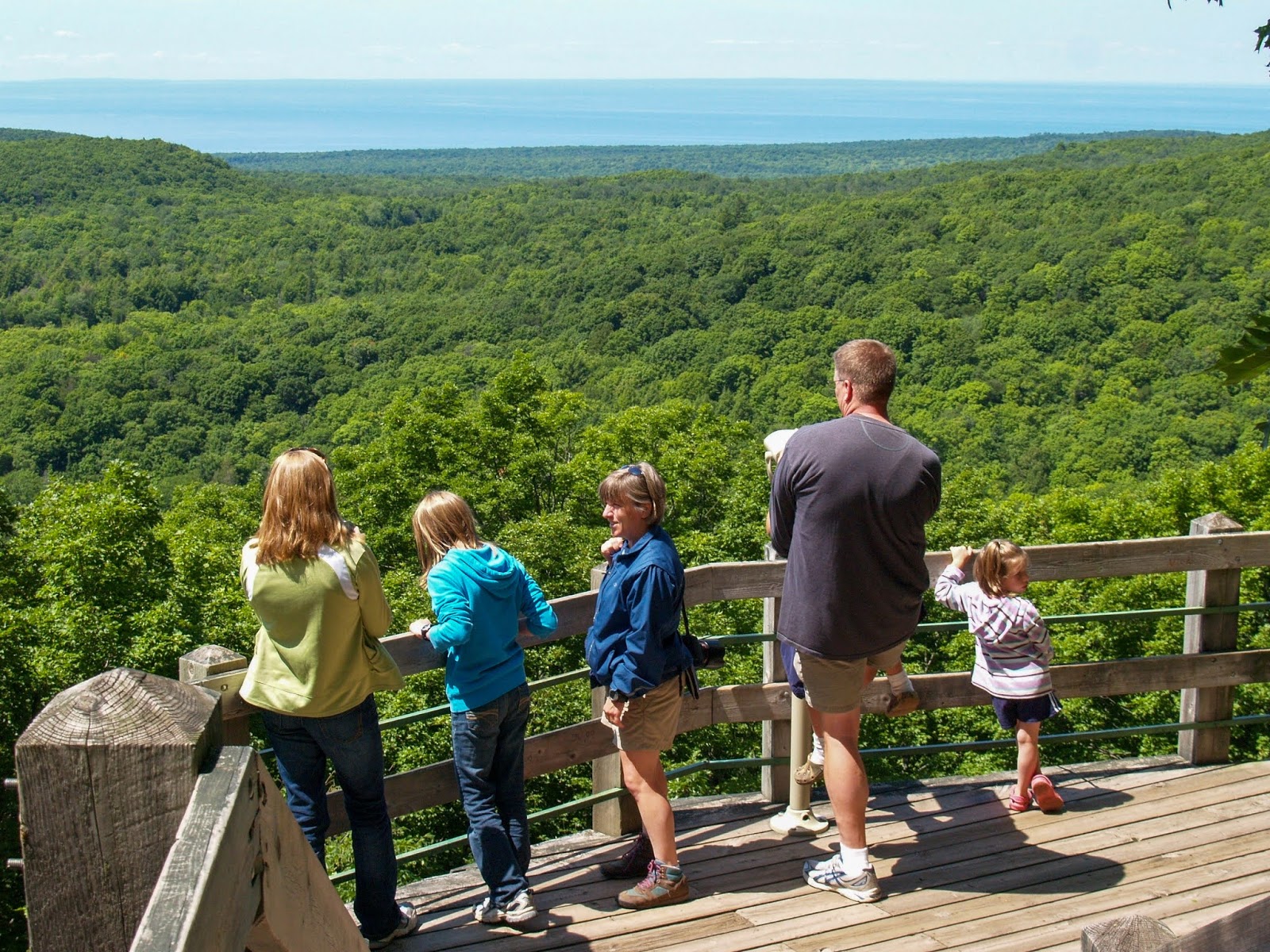
Perhaps the best known and most scenic area within the park is its Lake of the Clouds- a backcountry, 133-acre watershed that is surrounded by forest. As I recall, one of the most compelling views is on the hiking trail that approaches the lake from above. From here, the lake is completely visible with its surrounding forest stretching out in all directions. As you pan the distant edge of the lake; another view comes into focus – further below the lake’s edge and the forest that encircles it, the land falls away to expose a cream-colored shoreline as the :Lake Superior shoreline comes into focus some miles distant. The hiking trail that I took to the lake continued down to Lake Superior. It was inviting, but too long and too far away for me at that visit.

Lake of the Clouds Overlook


Many areas on the south shore of Lake Superior served as home base for numerous bands of Indians, most commonly Ojibwa and Odawa. The Indian history of the area prompted evocative place names lending credence to the rugged and deep forest mountain character of this area. Indian derived names include Miscowawbic Peak, Manabezho Falls, Mirror Lake, Lost Creek Outpost and Green Mountain Peak in addition to the aforementioned Lake of the Clouds.

If you are looking for a place to camp this summer, the Porcupine Wilderness State Park has much to offer as I learned many years ago.

(Information used in this blog was originally prepared by Michigan Department of Natural Resources employee JOHN PEPIN)


Saturday, May 9, 2020

Pandemics in America

Pandemics in America


When I was a boy growing up in Indiana, we played cowboys and Indians in the lawns around our neighborhood. On most days, those who were selected to be cowboys would wrap a bandana around their faces (like all good cowboys did to keep the dust out) and chase after those who were Indians for that day. If I was a cowboy, I always wanted to keep my bandana in place after the game ended but my mother said when I left the yard, I had to take it off. Fast forward 60-some years.

Things have turned upside down now that we are sheltered at home due to the corona virus pandemic. As a result, I spend most of my time in my own yard puttering around (adult playtime). Unlike my childhood days, my wife says if I leave our yard, I must be sure to put my mask ON in case I encounter a friend.

Our government leaders have enacted extraordinary rules about social interchange in response to the pandemic caused by the corona virus. The resulting disease is known as Covid 19, (19 to indicate the year the disease was first encountered). The disease is caused by the novel (a new virus) in the family of corona viruses. [Who decided to name it after a famous beer?] The deadly outbreak of this disease is easily the largest thing that has happened in my lifetime, eclipsing the horrors of both World War II, and Viet Nam in its ferocity of killing Americans. Monday’s news indicated that it was the deadliest day yet with the virus killing more than 3,000 Americans on one day. Twenty of our states have reported increases in the number of Covid 19 cases being reported with Michigan 3rd in the nation by reporting 4,000 new cases. In the same news, it was reported that most states are now ‘reopening’ their businesses despite recommendations from health officials that it is unwise.

How can it be that the calls to open our economy are occurring coincident with reaching new records in the number of deaths from this pandemic?

The passions concerning our economy are growing: In Michigan, armed men and women protested and entered the state house with swastikas, nooses, and military gear, demanding that the state re-open despite the certainty that more disease and more deaths will result. Several men among the protestors carried high-powered military guns and were dressed in make-believe military clothes, although there was not an honest-to-God military man among them. They reminded me of my boyhood playmates dressed in cowboy gear, strutting about for the cameras. “They are good people,” according to a government leader.

What are these people thinking?

The corona virus has taken over our nation and affected every American. Our President says that the rapid spread of the pandemic occurred in America because no one could see it coming. Such a poor excuse. The truth is that pandemics have occurred regularly in our history, both in the recent past and in the previous centuries and everyone involved in medicine and health knows this history with the apparent exception of those men and women appointed to high office by Donald Trump. Here is a thumb nail sketch of our history of pandemics that I discovered in a single afternoon.

EBOLA (1976 in Africa, 2014 in America)

 The first known outbreak of EVD was identified only after the fact. It occurred between June and November 1976 in  South Sudan near the Ebola River, and was caused by the Sudan virus (SUDV). The initial Sudan outbreak infected 284 people and killed 151. Since this outbreak, the virus has reappeared dozens of times in many countries, but primarily in Africa. The US has had only a few dozens of cases - primarily in 2014. The origin of the disease in America came from medical personnel who worked to help Ebola victims in Africa. Although the disease can be lethal, treatment for victims in America has been largely successful and the disease did not spread here because of successful mitigation efforts undertaken by former President Barack Obama.


Photo by Pablo Martinez Monsivais/AP
Nina Pham is hugged by Dr. Anthony Fauci, director of the National Institute of Allergy and Infectious Diseases, as she leaves the NIH hospital in Bethesda. Pham was diagnosed with Ebola on Oct. 12. Another Dallas nurse, Amber Vinson, was treated at Emory University Hospital, and physicians reported Ebola is no longer in her blood.


SARS (2002)
SARS, which stands for severe acute respiratory syndrome, is caused by the SARS coronavirus. It first infected people in late 2002 in China, and within weeks spread to 37 countries including the US. The virus infected 8,000 people, killing about 800. SARS, a corona virus that caused pneumonia was ultimately defeated by health officials around the world including US medical experts who were instrumental in combating this disease.

HIV/AIDS (1980’s)
The HIV virus infected 60 million people and caused an estimated 30 million deaths around the world. This virus was transmitted from one person to another primarily through sexual activity. This virus is still active in many parts of the world but it is less severe than earlier because of successful treatments with a cocktail of medications that were developed in response to the pandemic.

SMALLPOX (discovered on Egyptian mummies from the 3rd century AD)
Before smallpox was eradicated, it was a serious infectious disease caused by the variola virus. It was contagious by person to person contact and by handling blankets and clothing worn by those who had the disease. People who had smallpox had a fever and a distinctive, progressive skin rash. Most people with smallpox recovered, but about 3 out of every 10 people with the disease died. Smallpox came to America with Europeans who immigrated here. American Indians were highly susceptible to this disease as they had no immunity and it was rapidly transmitted throughout their nations causing death to all who were exposed but for a fortunate few.
The smallpox (variola virus), no longer exists in nature thanks to the success of vaccinations. No cases of naturally occurring smallpox have happened since 1977 with the last natural outbreak of smallpox in the United States in 1949.

SPANISH FLU (1918)
The influenza pandemic of 1918-1919 killed more people than those who died in World War I, somewhere between 20 and 40 million people. (Some estimates for the number of deaths from this outbreak are as high as 50 million.) It has been cited as the most devastating pandemic in recorded world history. More people died of influenza in a single year than in four-years of the Black Death/Bubonic Plague( see below). In the two years that this scourge ravaged the earth, a fifth of the world's population was infected. The flu was most deadly for people ages 20 to 40. This influenza virus had a profound virulence, with a mortality rate at 2.5% compared to the previous influenza epidemics, which were less than 0.1%. The death rate for 15 to 34-year-olds of influenza and pneumonia were 20 times higher in 1918 than in previous years.An estimated 675,000 Americans died of influenza during the pandemic. The effect of the influenza epidemic was so severe that the average life span in the US was depressed by 10 years. In 1918 American children skipped rope to the rhyme:
I had a little bird,
Its name was Enza.
I opened the window,
And in-flu-enza.

That influenza was sometimes referred to as the “Spanish Flu,” but that is a misnomer. The Historical Society of Michigan explained the origins of the inaccurate name: “Because of censorship associated with the Great War in Europe, the extent of influenza among both the Central Powers and the Allies was rarely reported. Spain, being neutral in the conflict, was not subjected to the same degree of restriction. Spanish publications often reported on the outbreak; hence the name Spanish Flu became common. The Spanish blamed the French as the source. In fact, the disease most likely originated at Camp Funston, Kansas since it reported the earliest outbreak" after the war ended and censorship was lifted.


This so-called Spanish Flu devasted all of America with the disease occurring everywhere in the US. Michigan was severely affected. Almost 15,000 Michigan residents died of flu or pneumonia between October 1918 and April 1919, and the age group with the highest mortality rate were young adults age 20 to 25.

People wearing cloth masks to protect themselves during this pandemic
During the 1918 flu pandemic, people wore masks but they provided limited protection against the virus. (Contributed by the Office of the Public Health Service Historian)
                       
The uptick in April 1918 represents the first, less lethal, wave of the influenza pandemic. The second wave, in which the flu virus had morphed into a much more deadly strain, struck Michigan in late September and deaths skyrocketed in October. By mid-October, the governor and state health department ordered the closing of churches and "places of public amusement," from movie theaters to saloons. Many communities also closed schools. After  those establishments were re-opened in November, deaths went up in December.” (Source: 1918-19 annual report from Michigan Commissioner of Health)


Another factor contributing to the rising death toll in December was how the disease spread in Michigan. The pandemic hit Michigan's urban centers first and the hardest. About three-quarters of all the deaths occurred in the southern third of the Lower Peninsula, and October was easily the worst month. In all, Michigan had four influenza outbreaks. The last large community outbreak occurred in 1920, more than two years after the initial introduction of the disease.


The central and northern Lower Peninsula and the Upper Peninsula -- including cities such as Grand Rapids and Saginaw -- were generally hit later, and the death toll in those counties peaked in November, December or even January 1919. Roscommon County with its 1918 population of 2998 souls saw a doubling of its death rate from 5.5 deaths per thousand residents in 1917 to 10.3 deaths per thousand in 1918.


BUBONIC PLAGUE OR BLACK DEATH (1347-1351)
Many nation states during the middle ages suffered through a contagious infection whose source was little understood and for which there were no known remedies. The infection was discovered not to result from a virus, but rather a bacterium. The pandemic spread rapidly through Asia, Europe, and Africa and killed an estimated 50 million people, perhaps one third of the entire population of Europe. The rate of death among untreated sufferers was 30 to 90 %. That the disease was known as the single most devastating tragedy the world had known accounts for the many tributes to its passing that are showcased in numerous town centers throughout Europe. Some of the large statues in town centers depict the suffering of hordes of people who were the ancestry of those towns and villages scattered throughout the urban areas.

The typical spread of the disease was from rats to fleas to people caused by the bacterium that became known as Yersinia pestis. The bacterium was spread in part by distribution of rats that accompanied trade from one nation to another including that which occurred as part of the ocean transport of goods with rats secreted amidst the bags and trunks used in international trade. The malady took its name from the blackening of victim’s skin as gangrene set in on parts of the body before death relieved the sufferer’s pain.

PLAGUE OF JUSTINIAN (541)
Another malady that occurred much earlier was the Plague of Justinian, a pandemic that originated during Roman times that was initially connected with capital city of Constantinople. This disease was initially recognized in 541 AD, with major recurrences until 750 AD. The disease is now easily cured by treatment with a variety of standard antibiotics. A vaccine for this malady has never been discovered, hence periodic breakouts have occurred in various locales until modern medicine is applied to interrupt the chain of transmission. It has been learned that The bacterium causing Black Death was the same that caused the Plague of Justinian and it continues to exist in nature today. Several cases of this plague have continued throughout the centuries with a recent outbreak in China in 2019 where four cases were recently confirmed.

So, what are we to learn from all these pandemics that have wreaked havoc on the world from the earliest times of human existence? I believe there are conclusions to be reached that are applicable to our current concerns with the novel corona virus and Covid 19.

1. Based on our past, serious health problems affecting large percentages of humans are inevitable; periodic outbreaks of diseases that defy available medications must be expected with regularity. Societies with rational leaders should be prepared for such emergencies.

2. Covid 19 will have recurrences over the next several months and perhaps years. It will not magically disappear without medical intervention that is not now available despite the happy talk of political leaders who are interested only in their personal well-being.

3. The only cure for the corona virus pandemic will be based on science and medical intervention. Until a treatment is available that cures the disease, and a vaccine becomes available that prevents its transmission, the disease will continue. The virus has no respect for a lack of economic activity or a surplus of same, only a citizenry dedicated to the defeat of the disease will win the battle.

Stay Safe, Bill

Friday, April 10, 2020

Earth Day  -  The Beginning and Now Its 50th Anniversary


Earth Day is the single most popular secular event held around the world. The event began in the United States in 1970 and was exported around the world by dedicated Americans and naturalists from other countries who held similar views. One of the founders was a man named Morton Hilbert from the U.S. Public Health Service who organized an environmental conference for students to learn about the effects of environmental degradation on human health. For the next two years, Hilbert and students worked to plan the first Earth Day. One of those who became interested in Hilbert’s work was U.S. Senator Gaylord Nelson who issued a proclamation for Earth Day after he toured an environmental disaster in California in 1969. While this Earth Day was focused on a United States event, a separate organization launched by Denis Hayes, who was the original national coordinator for the 1970 Earth Day event, made it international in 1990 and organized similar Earth Day events in 141 nations.

A major impetus for Earth Day began in the aftermath of two American environmental disasters. The first and perhaps most important was a disaster that occurred on January 28, 1969 in the form of an oil spill. The other event that ignited American public interest in the environment was the burning of a river. On June 22, 1969, the Cuyahoga River burst into flames in downtown Cleveland when sparks from a passing train set fire to oil-soaked debris floating on the water’s surface. These two disasters a few months apart provided the spark that ignited an environmental revolution.
When TIME Magazine published dramatic photos of the burning river — so saturated with sewage and industrial waste that it “oozes rather than flows,” concern erupted nationwide. The flaming Cuyahoga became a figurehead for America’s mounting environmental issues and sparked wide-ranging reforms. Note that the picture below was taken in 1952 – evidence that the river has burned several times. In fact, the 1969 burning is a victory of sorts, it is the last time the river burned. Here is the rest of the story.

The Cuyahoga River Fire of 1952 near downtown Cleveland

The worst environmental disaster in the United States in 1969 was the oil spill off the coast of Santa Barbara, California that occurred a few months before the burning of the river in Cleveland. From an oil industry perspective, Santa Barbara was about the worst place imaginable for an oil spill to occur, especially an event of the magnitude that occurred in a place loved my many vacationers. Of the many places that attract tourists, Santa Barbara is one of the best; a picturesque small town facing the south that is pinched between a lovely beachfront shoreline and the scenic mountains behind.


Santa Barbara Shoreline John Wiley User:Jw4nvc - Santa Barbara, California

In the mid 1960’s, the love affair between Americans and their automobiles provoked a cultural change. Their dependence upon autos for most facets of everyday life stimulated an unprecedented demand for gasoline. American oil marketers, the so-called Big Oil companies, were only too happy to respond by drilling wells anywhere and everywhere that oil could be found. One of those places was just off the coast of Santa Barbara, California.
The city and county authorities in Santa Barbara wanted to be certain that drilling for oil would do nothing to harm their tourist business, so they placed restrictions on the oil companies who wanted to drill for the readily accessible oil beneath the ocean’s surface.

Offshore drilling for oil was nothing new to Santa Barbara since it had begun there in 1897. A man named H.L. Williams is credited with drilling a well from a wooden pier in the Santa Barbara Channel in 1897, the first to be drilled entirely in the ocean. He used an island pier to support a land rig located next to an existing oil field. The well was successful for several years, but local authorities wanted to be sure that drilling in the region would not spoil their burgeoning tourist business. California's state authorities heeded their views and established regulations covering the property owned by the state, thus effectively ending offshore oil drilling. But the lure of profits from oil seemed irresistible. By the late 1960's, oil interests had petitioned the US government for drilling rights in federally controlled areas beyond the reach of locals. Off-shore drilling began once again, this time in waters controlled by the Federal Government.

A new boom in off-shore drilling began in the 1960’s after deep well drilling rigs were perfected for off-shore use. A number of rigs began operating around Santa Barbara as soon as the feds sold drilling rights. Union Oil was one of the winning bidders who designed and developed new rigs for new field. Shortly after an off-shore drilling rig was completed, drilling began on new Platform A in January of 1969. By the end of the month several wells had been completed and plans were in place for oil pumping as soon as the delivery systems were in place. But then Platform A had a sudden problem: the new well suddenly blew out; the crew had a gusher that was sending gas, oil, and mud upwards, coating the roustabouts on the platform with a filthy mix of salt water, drilling mud and oil. The drillers knew exactly what to do. They withdrew the drilling pipe and bit and replaced it with a 'blow-out preventer'--a stiff pipe inserted into the well casing with provisions for a cap on its end. The pressure was too much, they were unable to screw the cap in place to prevent the high-pressure oil and gas from its explosive flow. Sensing their failure, the drillers tried a measure of last resort; dropping the entire length of drill pipe, nearly a 1/2-mile-long into the hole they had pierced into the sea floor. As the last section of pipe was attached, the men worked quickly to crush the top of the pipe into a flat section that prevented further flow of oil and gas. It had taken them just 13 minutes to complete the emergency ‘last resort’ operation. They cheered their good fortune as the explosive flow of oil stopped. They had successfully capped the well and stopped the leak. Only it wasn't stopped, the leak simply moved somewhere else.

The first announcement of the potential disaster was made by Union Oil's regional superintendent about two and a half hours after the blowout. The superintendent told the Coast Guard that a well had blown out, but no oil was escaping. The superintendent then held a news conference to announce the spill and the successful capping operation. Everything is under control, he said.  Shortly after the cap was installed an oil bubble and oil slick was noticed near the site of the well. Just residual oil from the leak, they seemed to think.

The seriousness of the spill became evident the next morning when a Coast Guard helicopter took Union Oil Superintendent Brown along with a State Fish and Game warden out over the platform, where they saw a central oil slick that extended several miles east, west, and south of the platform. They estimated a total of 75 square miles was covered by oil less than 24 hours after the blowout. An anonymous worker on the drill rig had telephoned the Santa Barbara News-Press regarding the blowout and the story was out. A Union Oil Vice President, John Fraser, assured reporters and local officials that the spill was small, with a diameter of 1,000 to 3,000 feet, and the leak would be quickly controlled. He said the estimated spill was about 5,000 US gallons. (Later estimates put the spill rate in the first days at about 210,000 US gallons per day).
 
In the next several hours, sharp-eyed observers noticed more oil slicks in the waters surrounding the nearby islands. Finally it dawned on the oil company executives, that the high pressure of the oil and gas beneath had broken through the weak, sandy soil at the ocean bottom and oil was spewing from several ruptures in the earth, many distant from the original drill hole. Evidence of the leaking oil began to be understood as oil slicks began appearing on beaches all around the area. Initially it seemed that no one knew how to control the flow and fix the leak that continued for the next several days. Over the ten-day period of the leak, 80,000 to 100,000 barrels of crude oil spewed from the failed well into the clear coastal waters at a leak rate in excess of 100,000 gallons per hour. It was the largest oil spill in United States waters by that time, and now ranks third after the 2010 Deepwater Horizon leak in the Gulf of Mexico and 1989 Exxon Valdez spill off the coast of Alaska. It remains the largest oil spill to have occurred in the waters off California as result of Union Oil's leak at platform A on the Santa Barbara coast.


Beach clean-up operations at Santa Barbara using straw to absorb oil

The leak galvanized both local and national action to remedy the damage done. Techniques for clean-up of the spilled oil was rudimentary; workers used whatever they had at hand in trying to soak up the oil that was fouling the precious beaches.

The leak became both local and national news. Activists around the country pointed to the leak as an example of failed policies of the US government concerning protection of natural resources. In February of 1969, the President of Union Oil arrived in southern California to see for himself what had happened. He was heckled at the airport and an instant demonstration against big oil erupted. The Santa Barbara spill alarmed the country and awakened those who felt action was needed.

President Nixon was stirred to action. He visited Santa Barbara in March and walked the beach to witness the environmental damage caused by the oil leak and get his picture taken while he talked to local people worried about the problem. His presence furthered the energy of those activists who wanted change. Some months later the Cuyahoga River caught fire in Cleveland and added fuel to the nation’s mood for environmental activism. The two local events quickly fused a national movement for natural resource activism. Four months after his Santa Barbara visit, Nixon established an environmental council in his Cabinet, and in 1970, he established the Environmental Protection Agency and gave the new organization the authority to propose numerous pieces of environmental legislation. Within the next several years, legislation was implemented that now forms the legal and regulatory framework for the modern environmental movement in the U. S.

The first Earth Day was celebrated that same year.